
Redness & Irritation
Psoriasis
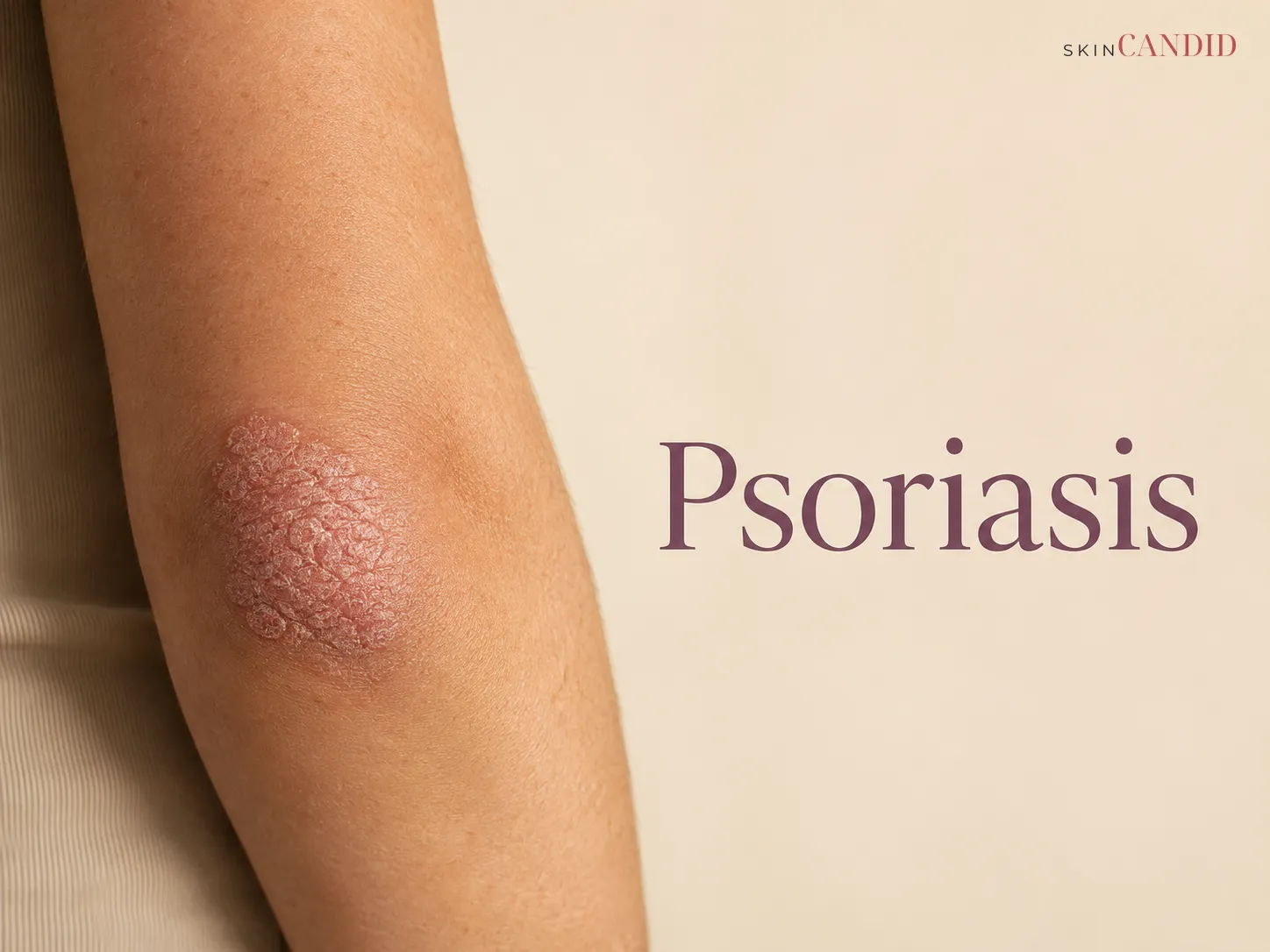
Psoriasis is a chronic immune-mediated skin condition that causes well-defined, thickened, scaly plaques, most often on the elbows, knees and scalp, driven by skin cells growing far faster than normal.
Overview
What is psoriasis?
Psoriasis is a chronic immune-mediated condition in which skin cells are produced much faster than they can shed, leading to a build-up of thickened, scaly plaques. Plaque psoriasis is the most common form.
It typically affects the elbows, knees, scalp and lower back, though it can appear anywhere, including the nails and joints. It can begin at any age, with peaks in early adulthood and again later in life.
Common signs and patterns
What psoriasis can look or feel like
These features can provide context, but they do not confirm a diagnosis on their own.
Thickened, well-defined plaques
Raised patches with clear borders, often covered in a silvery-white scale.
Scalp involvement
Scaly, sometimes itchy patches on the scalp that can extend past the hairline.
Nail changes
Pitting, thickening or separation of the nail can occur alongside skin plaques.
Joint pain or stiffness
A subset of people with psoriasis develop psoriatic arthritis, with joint pain, stiffness or swelling.
Causes and contributors
Psoriasis is driven by the immune system, not by anything applied to the skin.
Overactive immune signalling drives skin cells to multiply far faster than normal. Genetics play a strong role, and flares can be triggered by infections such as strep throat, skin injury, stress, certain medications and cold weather.
Exactly why psoriasis starts or flares varies between individuals and is not fully predictable.
What it may be confused with
Similar-looking concerns need different decisions
Thickened or scaly patches should not automatically be treated as psoriasis, especially when the texture, borders or triggers do not fit.
Eczema
Tends to have softer, less defined patches and more intense itch, without the thick silvery scale typical of psoriasis plaques.
Seborrheic dermatitis
Produces greasier, yellowish scale concentrated on the scalp, eyebrows and nasolabial folds rather than thick, well-defined plaques.
Keratosis pilaris
Presents as small rough follicular bumps rather than the larger, well-defined plaques typical of psoriasis.
A fungal infection (ringworm)
A single scaly, ring-shaped patch with a fungal cause needs antifungal treatment rather than psoriasis treatment, and a simple test can tell them apart.
Bottom line
Consistent topical treatment controls limited psoriasis; more extensive disease needs a broader plan.
Topical corticosteroids and vitamin D analogues, often combined, are first-line for limited plaques and need several weeks of consistent use.
Psoriasis affecting a large body surface area, the scalp extensively, the nails, or the joints often needs a systemic or biologic approach chosen by a specialist.
Evidence-supported options
Choose the option that matches how much skin is affected
This is general education, not a personal treatment plan. Product strengths, permitted uses and prescription status vary by country.
Topical corticosteroids
The most effective topical monotherapy for plaque psoriasis, with strong short-term evidence for reducing plaques.
Limit: Prolonged high-potency use risks skin thinning, stretch marks and rebound flare when stopped abruptly.
Vitamin D analogues
Calcipotriene or calcitriol are effective alone and more effective when combined with a topical corticosteroid than either alone.
Limit: Should not be combined with salicylic acid or paired with oral vitamin D supplements, and use is typically limited to under 30% of body surface area.
Combination and rotational regimens
Alternating a vitamin D analogue with a corticosteroid, or combining tazarotene with a corticosteroid, can extend the treatment effect.
Limit: Requires a clear regimen and monitoring to manage irritation and safety limits.
Systemic or biologic therapy
Oral systemic medications or biologic injections may be appropriate for widespread, joint-related or treatment-resistant psoriasis.
Limit: Requires specialist diagnosis, monitoring and consideration of infection risk and other health conditions.
Supportive skincare
A simple routine while psoriasis is being managed
Supportive skincare should reduce scaling and cracking and support treatment tolerance. It does not replace the selected psoriasis treatment.
Morning
- Cleanse gentlyUse a mild cleanser without scrubbing plaques.
- Apply treatment if directedFollow the product label or clinician’s instructions.
- Moisturise and protectUse a fragrance-light moisturiser and sunscreen on unaffected skin.
Evening
- Cleanse gentlyAvoid picking or scrubbing at scale.
- Use the selected treatmentApply directly to plaques as directed.
- Moisturise generouslyA thick moisturiser can reduce scaling and cracking overnight.
Common mistakes
What can make psoriasis harder to assess or manage
- Scrubbing or picking at scale, which can trigger new plaques at the site of skin injury.
- Stopping topical treatment as soon as plaques flatten, rather than tapering as directed.
- Assuming psoriasis is contagious or hygiene-related and avoiding necessary treatment out of embarrassment.
- Ignoring new joint pain or stiffness, which can be an early sign of psoriatic arthritis.
When professional help makes sense
Seek assessment when plaques are extensive, worsening, or joints are involved.
- Plaques covering a large area of the body, or rapidly worsening psoriasis
- Joint pain, stiffness or swelling that could suggest psoriatic arthritis
- No meaningful improvement after a consistent course of topical treatment
- Psoriasis affecting the nails, scalp extensively, or areas that significantly affect daily life or confidence
Related reading
Continue with the next useful question
Editorial record
What this page knows, and what remains uncertain
Evidence summary
Current AAD-NPF guidance supports topical corticosteroids and vitamin D analogues, alone or combined, as first-line for limited plaques, with systemic or biologic therapy reserved for widespread, joint-related or treatment-resistant disease.
Review status
Evidence reviewed 25 July 2026. Medical and practical reviewer approval remain pending and must not be implied until completed. The hero image also remains pending dermatologist-reference comparison and Medical Visual Approval.
Financial transparency
No paid product placement or affiliate ranking is included on this foundation page.
Recommendation logic
Options are organised by how much body surface area is affected, evidence grade, safety limits and the point at which specialist systemic or biologic care becomes more appropriate.
Frequently asked questions
Short answers to common questions
Is psoriasis contagious?
No. Psoriasis is an immune-mediated condition and cannot be spread by touch.
Can psoriasis be cured?
No, but it can be well managed with topical, systemic or biologic treatment depending on severity, with long periods of clear or nearly clear skin possible.
Why do my plaques have silvery scale?
The scale forms because skin cells are produced and shed far faster than normal, building up on the surface.
Can psoriasis affect joints?
Yes. A subset of people develop psoriatic arthritis, so new joint pain or stiffness is worth mentioning to a clinician.
Sources reviewed
Guidance behind this page
- American Academy of Family Physicians: Psoriasis — Update on Topical Therapy From the AAD
- Journal of the American Academy of Dermatology: AAD–NPF joint guidelines on topical therapy
- National Psoriasis Foundation: Psoriasis guidelines
Sources support general editorial guidance. They do not replace regional product labels, prescribing information or personal medical assessment.