
Dryness & Barrier
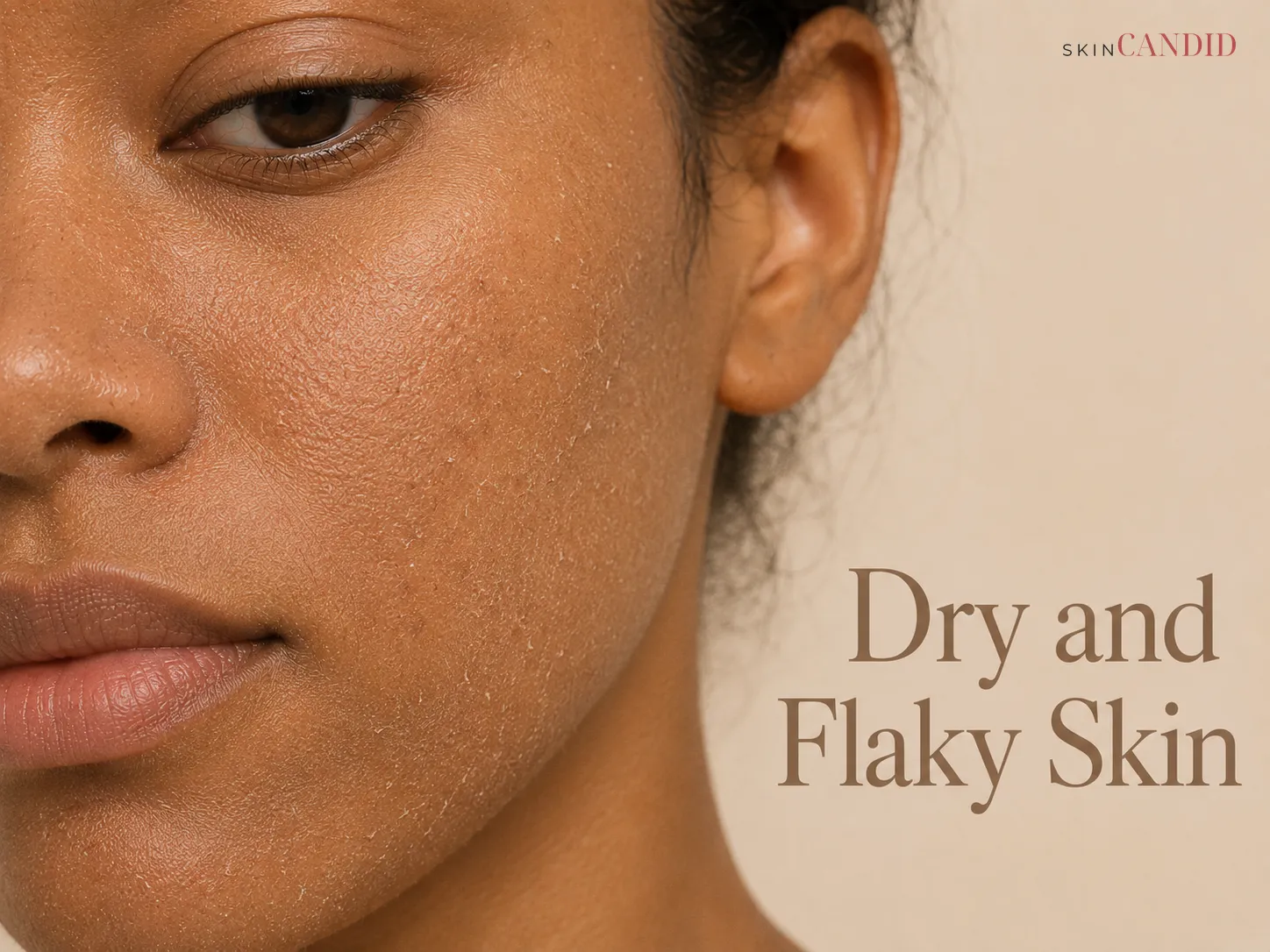
Dry and Flaky Skin
Dry and flaky skin describes visible flaking and rough texture that can affect anyone temporarily, from weather, harsh products or over-exfoliation, distinct from Dry Skin as an ongoing skin type.
Overview
What is dry and flaky skin?
Dry and flaky skin is a visible concern, meaning it describes a temporary state of the skin’s surface rather than a fixed characteristic. It can happen to any skin type when moisture is lost faster than it is replaced, showing up as rough patches or fine flakes, often around the cheeks, nose and mouth.
This is different from Dry Skin as a skin type, which describes an ongoing, constitutional tendency to produce less oil. Someone with naturally oily skin can still experience a flaky episode, while someone with the Dry Skin type may need ongoing management beyond what resolves a single flaky patch.
Common signs and patterns
What dry and flaky skin can look or feel like
These features can provide context, but they do not confirm a diagnosis on their own.
Visible flakes or rough patches
Often most noticeable around the cheeks, nose, mouth and eyebrows, where skin can lose moisture more quickly.
Tightness after cleansing
A pulled or tight feeling shortly after washing can point to moisture being stripped from the surface.
Flaking that follows a new active ingredient
New flaking shortly after starting a retinoid or acid can point toward over-exfoliation rather than an ongoing skin type.
Flaking limited to certain seasons or areas
Dryness that comes and goes with weather or specific products is more likely a temporary concern than the ongoing Dry Skin type.
Causes and contributors
Flaking usually reflects a temporary imbalance in the skin’s moisture and barrier.
Cold or dry weather, hot showers, harsh cleansers and over-washing can all strip the skin’s natural oils faster than it can replace them. Introducing a new retinoid or acid too quickly, or combining several strong actives, can also disrupt the surface and cause visible flaking.
An already compromised skin barrier can make flaking more likely and slower to resolve until moisture and lipid levels are restored.
What it may be confused with
Similar-looking concerns need different decisions
Visible flaking can point to several different underlying issues.
Dry Skin (skin type)
An ongoing, constitutional tendency toward lower oil production, rather than a temporary flaky episode.
Damaged skin barrier
A broader concern that can include flaking alongside stinging, redness and heightened sensitivity.
Over-exfoliated skin
Flaking that follows introducing too many strong actives at once points to this specific, self-limiting cause.
Eczema
A distinct inflammatory condition that can cause flaking alongside persistent itching and defined patches.
Bottom line
Simplify the routine first, then rebuild moisture and barrier support.
Most temporary flaking responds well to a short pause on active ingredients and a consistent, fragrance-free moisturising routine.
Flaking that continues despite these steps, or that involves ongoing lower oil production, may point to the Dry Skin type or another underlying concern.
Evidence-supported options
Choose the option that fits how the flaking started
This is general education, not a personal treatment plan. Product strengths, permitted uses and prescription status vary by country.
Fragrance-free moisturiser with ceramides
Helps restore lipids to the skin’s surface and support its natural barrier.
Limit: Works best applied to slightly damp skin and paired with gentler cleansing.
Gentle cleansing with lukewarm water
Reduces further stripping of natural oils compared with hot water or harsh cleansers.
Limit: Helpful for prevention, but may not resolve flaking already present on its own.
Humectants such as hyaluronic acid or glycerin
Add water content to the skin, which can be sealed in with a moisturiser afterward.
Limit: In very dry conditions, humectants alone may not be enough without an occlusive layer.
Dermatologist assessment
Useful when flaking persists or when an underlying condition such as eczema is suspected.
Limit: Not usually needed for a straightforward, short-lived flaky episode.
Supportive skincare
A simple routine to resolve flaking
Supportive skincare should focus on rebuilding moisture and reducing further irritation while flaking settles.
Morning
- Cleanse gently, or rinse with water onlyAvoid stripping the surface further while it recovers.
- Apply a hydrating serumSupport water content before moisturiser.
- Moisturise and protectFollow with a richer moisturiser and daily sunscreen.
Evening
- Cleanse once, gentlyRemove sunscreen and makeup without scrubbing.
- Pause exfoliants and retinoidsWait until flaking has settled before reintroducing actives.
- Moisturise generouslyUse a richer, ceramide-containing formula overnight.
Common mistakes
What can make dry and flaky skin harder to resolve
- Trying to scrub or exfoliate flakes away, which can worsen irritation and prolong recovery.
- Continuing a retinoid or acid at the same strength despite visible flaking.
- Using hot water or harsh cleansers that strip the skin’s remaining natural oils.
- Assuming every flaky episode means having the Dry Skin type long-term.
When professional help makes sense
Seek assessment when flaking persists or comes with other symptoms.
- Flaking that continues beyond a few weeks despite a simplified, gentle routine
- Flaking accompanied by persistent redness, cracking, itching or pain
- Uncertainty about whether the pattern reflects a temporary concern, the Dry Skin type, or a condition such as eczema
- Flaking that keeps recurring in the same areas despite consistent care
Related reading
Continue with the next useful question
Editorial record
What this page knows, and what remains uncertain
Evidence summary
Current dermatology sources describe temporary flaking as usually resolving with gentle cleansing, moisturising and a simplified routine, distinct from the ongoing Dry Skin type or an underlying skin condition.
Review status
Financial transparency
No paid product placement or affiliate ranking is included on this foundation page.
Recommendation logic
Options are organised by evidence grade and the point at which professional assessment becomes a reasonable addition.
Frequently asked questions
Short answers to common questions
Is dry and flaky skin the same as having the Dry Skin type?
Not necessarily. Dry and flaky skin can be a temporary concern affecting any skin type, while the Dry Skin type describes an ongoing, constitutional tendency to produce less oil.
How long does a flaky skin episode usually last?
Many temporary flaky episodes settle within days to a couple of weeks with a simplified routine and consistent moisturising.
Should I exfoliate flaky skin to remove the flakes faster?
Exfoliating flaky skin can often make irritation worse; it is usually better to pause exfoliants and focus on moisturising until the flaking settles.
Can over-exfoliation cause dry and flaky skin?
Yes. Using too many strong exfoliating acids or retinoids at once is a common cause of temporary flaking and irritation.
Sources reviewed
Guidance behind this page
- Cleveland Clinic: Dry skin (xeroderma) — symptoms, causes and treatment
- Cleveland Clinic: Peeling skin — causes, diagnosis and treatment
- Cleveland Clinic: Tips for getting rid of dry skin on your face
Sources support general editorial guidance. They do not replace regional product labels, prescribing information or personal medical assessment.