
Dryness & Barrier
Over-Exfoliated Skin
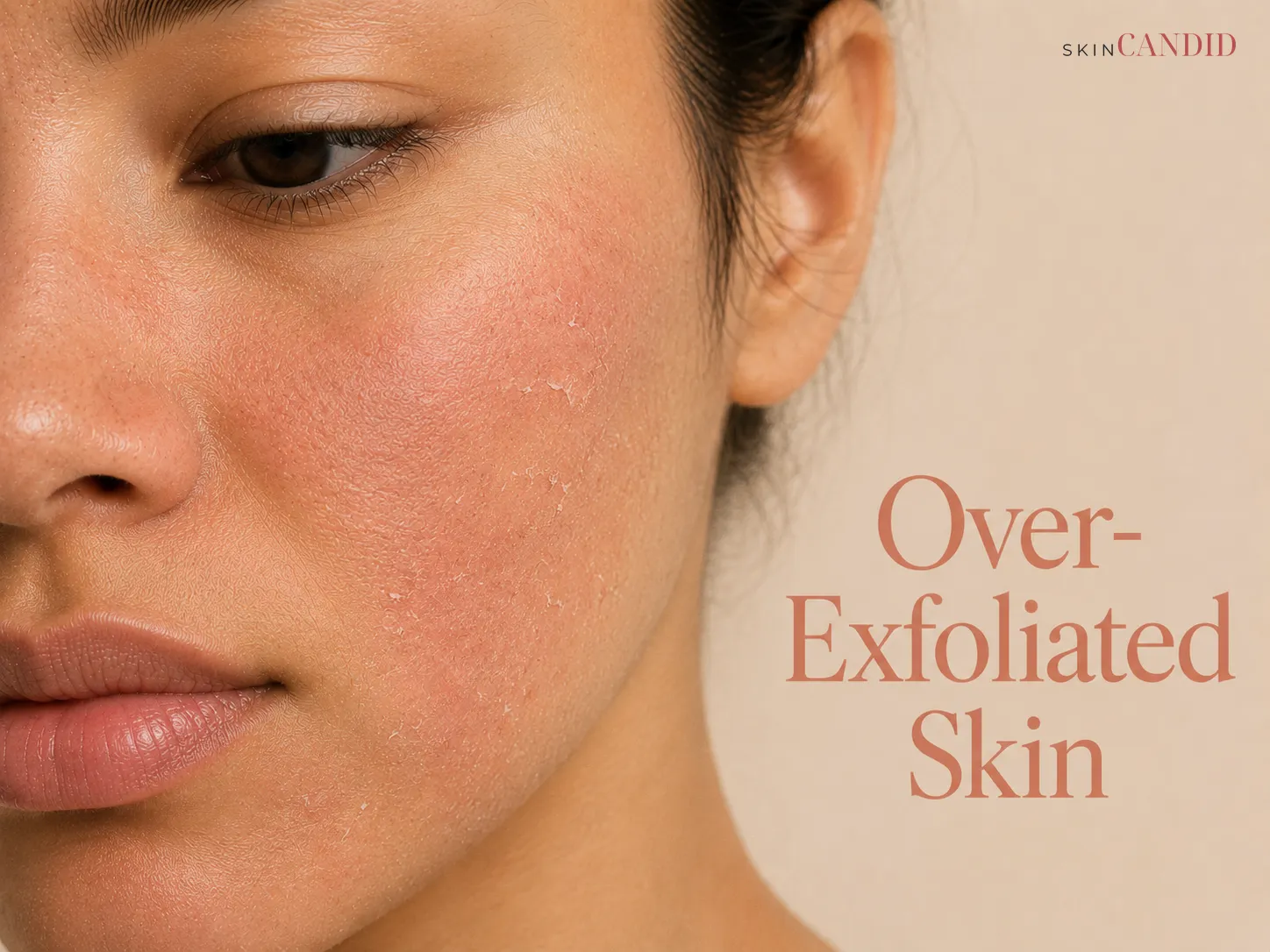
Over-exfoliated skin describes damage from excessive or harsh exfoliation, showing up as redness, stinging and sensitivity as the skin barrier becomes compromised and needs time to recover.
Overview
What is over-exfoliated skin?
Over-exfoliated skin is the result of exfoliating too often, too aggressively, or with too many strong products layered together, faster than the skin can recover between uses. It typically presents as redness, stinging, tightness and a compromised barrier rather than any smoother or clearer appearance.
This is distinct from a general damaged skin barrier, which can have several causes, and from ongoing irritated skin unrelated to recent exfoliation.
Common signs and patterns
What over-exfoliated skin can look or feel like
These features can provide context, but they do not confirm a diagnosis on their own.
Redness or stinging with usual products
Products that were previously well tolerated may suddenly cause discomfort once the barrier is compromised.
Tight, rough or flaky texture
Visible flaking or rough patches can appear soon after exfoliating too often or too aggressively.
Increased reactivity to skincare
Skin may sting or flush with products it previously tolerated, including plain moisturiser in more severe cases.
A shiny or “raw” appearance
More severe cases can leave skin looking overly smooth or shiny where the surface barrier has been stripped.
Causes and contributors
Over-exfoliation usually comes from too much, too often, or too many products at once.
Combining several strong exfoliating acids, retinoids or physical scrubs in the same routine, exfoliating more often than the skin can tolerate, or moving to a higher strength before the skin has built tolerance can all overwhelm the skin’s surface faster than it can repair itself.
Layering exfoliation with other irritants, such as fragranced products or additional active ingredients, can compound the effect.
What it may be confused with
Similar-looking concerns need different decisions
Redness and sensitivity can point to several different underlying issues.
Damaged skin barrier
A broader concern with several possible causes; over-exfoliation is one specific and common trigger.
Dry and flaky skin
Flaking can have several causes; over-exfoliation is a common one when flaking follows a recent change in actives.
Facial redness
Persistent redness unrelated to a recent change in exfoliation may reflect a different underlying pattern.
Rosacea
An ongoing condition with flushing and bumps that is separate from short-term irritation caused by exfoliation.
Bottom line
Pause actives, simplify the routine, and let the barrier rebuild before reintroducing anything new.
Most over-exfoliated skin improves within a few days to a couple of weeks once exfoliants and other strong actives are stopped.
Reintroduce any exfoliating product slowly and at a lower frequency once skin has fully settled, rather than returning to the previous routine all at once.
Evidence-supported options
Choose the option that fits the severity of irritation
This is general education, not a personal treatment plan. Product strengths, permitted uses and prescription status vary by country.
Pause all exfoliants and active ingredients
Stopping acids, retinoids and scrubs gives the barrier the best chance to recover.
Limit: Requires patience, as visible improvement is gradual rather than immediate.
Fragrance-free moisturiser with ceramides
Supports the skin’s lipid barrier while it repairs.
Limit: Recovery can be slower if damage is more severe or repeated.
Minimal, gentle cleansing
Reduces further stripping while other steps support barrier recovery.
Limit: Supportive rather than a stand-alone repair strategy.
Dermatologist assessment
Useful when irritation is severe, persistent, or shows signs of infection.
Limit: Not usually needed for mild, short-lived irritation that improves with simplification.
Supportive skincare
A simplified routine while skin recovers
Supportive skincare should reduce every unnecessary step until the barrier has settled.
Morning
- Rinse with water or a very gentle cleanserAvoid anything that strips or foams heavily.
- Apply a barrier-support moisturiserChoose a fragrance-free formula with ceramides.
- Protect with sunscreenUse a gentle, mineral formula if skin feels sensitive.
Evening
- Cleanse gently onceRemove sunscreen without scrubbing or double cleansing.
- Skip all exfoliants and activesPause acids, retinoids and scrubs entirely until skin settles.
- Moisturise generouslyApply a richer barrier-repair formula overnight.
Common mistakes
What can make over-exfoliated skin harder to recover from
- Continuing to exfoliate through stinging or redness in hopes the skin will “toughen up.”
- Introducing several new actives at once, making it hard to identify what caused the irritation.
- Adding more products to try to fix irritation rather than simplifying the routine.
- Returning to the previous exfoliation frequency as soon as skin looks slightly better.
When professional help makes sense
Seek assessment when recovery stalls or symptoms are severe.
- No improvement after a couple of weeks of a simplified, barrier-focused routine
- Signs of infection, such as increasing pain, swelling or discharge
- Severe stinging, burning or widespread reaction rather than mild, localised irritation
- Uncertainty about whether the cause is over-exfoliation or an underlying condition such as rosacea or dermatitis
Related reading
Continue with the next useful question
Editorial record
What this page knows, and what remains uncertain
Evidence summary
Current dermatology-aligned guidance links over-exfoliation to redness and irritation, supporting a pause on active ingredients and consistent barrier-focused moisturising as first-line recovery steps.
Review status
Financial transparency
No paid product placement or affiliate ranking is included on this foundation page.
Recommendation logic
Options are organised by evidence grade and the point at which professional assessment becomes a reasonable addition.
Frequently asked questions
Short answers to common questions
How do I know if I have over-exfoliated my skin?
Signs include redness or stinging with products you previously tolerated, tightness, flaking, or a shiny, raw appearance, usually following recent or frequent use of exfoliating acids, retinoids or scrubs.
How long does it take skin to recover from over-exfoliation?
Many cases improve within a few days to a couple of weeks once exfoliants are paused and a simple, barrier-supporting routine is followed.
Should I keep using my retinol if my skin is irritated?
Continuing an active ingredient through significant irritation usually prolongs recovery; it is generally better to pause it until the skin has settled, then reintroduce it gradually.
Is over-exfoliated skin the same as a damaged skin barrier?
Over-exfoliation is one common cause of a damaged skin barrier, but the barrier can also be disrupted by other factors such as weather, harsh products or an underlying skin condition.
Sources reviewed
Guidance behind this page
- American Academy of Dermatology: How to safely exfoliate at home
- Cleveland Clinic: Tips for getting rid of dry skin on your face
- Cleveland Clinic: Peeling skin — causes, diagnosis and treatment
Sources support general editorial guidance. They do not replace regional product labels, prescribing information or personal medical assessment.