
Breakouts & Pores
Post-Acne Marks
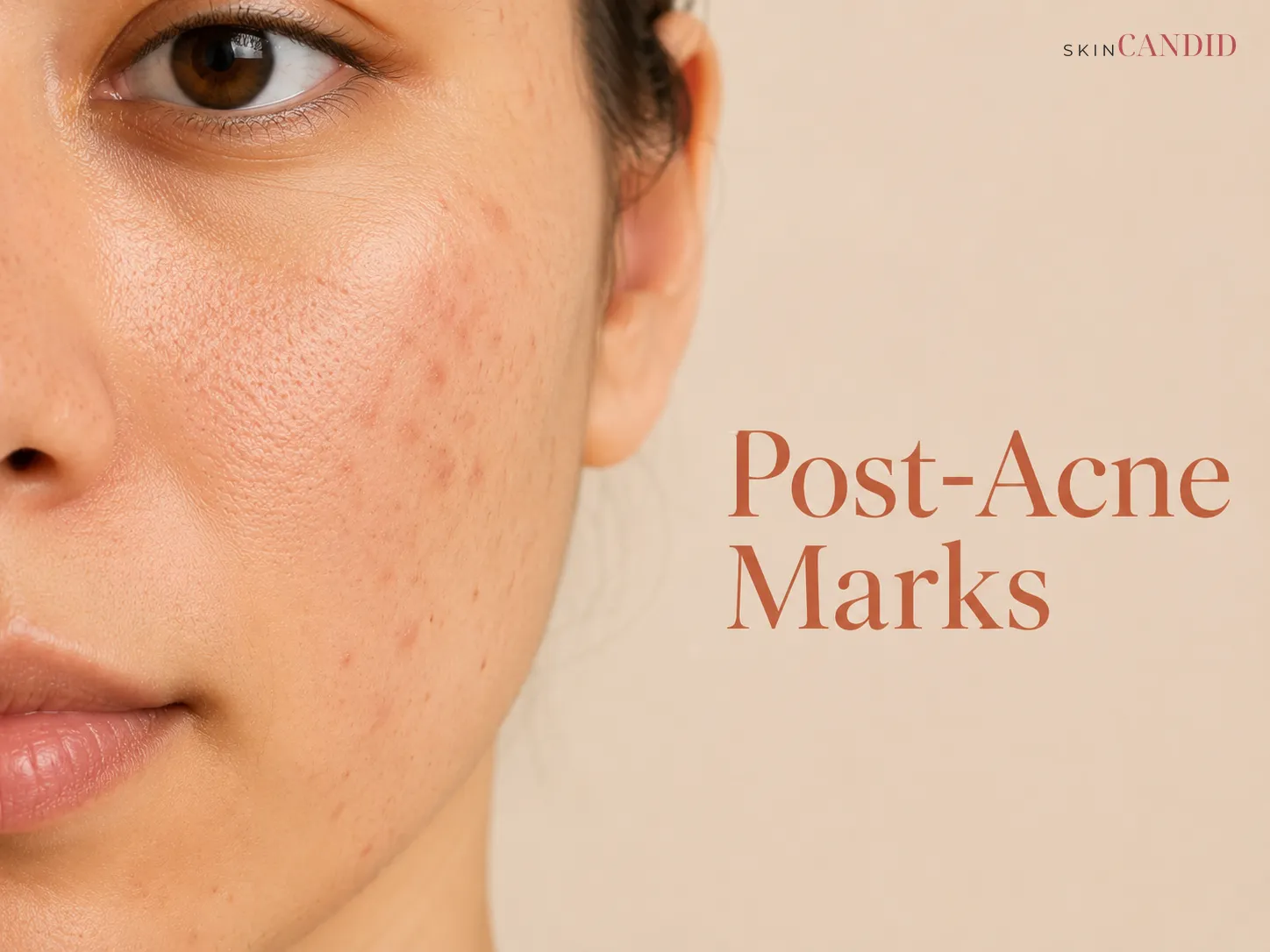
Post-acne marks are the flat red, pink, brown or dark discolouration left behind after a blemish heals, and they are different from the textured indentations of true acne scars.
Overview
What are post-acne marks?
Post-acne marks are flat areas of discolouration that remain after a pimple has healed. They form because the inflammation of acne affects blood vessels near the surface, leaving temporary redness, or triggers extra pigment production, leaving temporary brown discolouration.
Unlike acne scars, post-acne marks do not change the skin’s texture. They sit flat and, in most cases, fade without any permanent change to the skin.
Common signs and patterns
What post-acne marks can look or feel like
These features can provide context, but they do not confirm a diagnosis on their own.
Flat, not raised or indented
Post-acne marks sit level with surrounding skin rather than forming a bump or a dip.
Pink, red or purple tone
Marks with this tone reflect residual redness from healed inflammation, sometimes called post-inflammatory erythema.
Brown or tan tone
Marks with this tone reflect extra pigment production, sometimes called post-inflammatory hyperpigmentation, and are more common and longer-lasting in deeper skin tones.
Improves without texture change
Marks that fade over months without leaving a permanent dip or raised area are marks, not scars.
Causes and contributors
Post-acne marks form from the skin’s healing response to inflammation.
When a blemish heals, nearby blood vessels can stay temporarily dilated, causing redness, or melanocytes can produce extra pigment in response to inflammation, causing brown discolouration. Picking or squeezing a blemish increases inflammation and makes marks more likely and more stubborn.
Sun exposure during the healing period can intensify and prolong brown marks in particular.
What it may be confused with
Similar-looking concerns need different decisions
Discolouration after acne should not automatically be treated as a scar or as melasma.
Acne scars
Involve an actual change in texture, such as an indentation, rather than flat discolouration alone.
Melasma
Larger, symmetrical patches typically linked to hormones and sun rather than individual healed blemishes.
Hyperpigmentation
A broader category of dark spots that can come from acne, sun exposure or other skin injury.
Active acne
Raised, often tender lesions rather than the flat marks left behind once a blemish has healed.
Bottom line
Sunscreen and patience do most of the work; targeted ingredients can help brown marks fade faster.
Most post-acne marks improve over weeks to months without aggressive treatment.
Daily sun protection prevents marks from darkening further and getting stuck in place.
Evidence-supported options
Choose the option that fits your skin’s tolerance
This is general education, not a personal treatment plan. Product strengths, permitted uses and prescription status vary by country.
Daily broad-spectrum sunscreen
Prevents brown marks from darkening further and helps them fade on a normal timeline.
Limit: Prevents worsening rather than actively erasing existing marks.
Topical retinoids
Can speed the fading of brown post-acne marks alongside preventing new acne.
Limit: Can cause irritation or increased sun sensitivity when introduced.
Azelaic acid
Can help fade brown discolouration and is generally well tolerated, including in sensitive skin.
Limit: Results build gradually over several weeks.
Chemical peels or laser treatment
Can be considered for stubborn brown marks that do not respond to a topical routine.
Limit: Carries a risk of worsening pigmentation in some skin tones if not performed with appropriate expertise.
Supportive skincare
A simple routine while post-acne marks fade
Supportive skincare should protect healing skin and avoid adding new inflammation.
Morning
- Cleanse gentlyUse a mild cleanser without scrubbing at marks.
- Apply treatment if directedFollow the product label or clinician’s instructions.
- Apply sunscreenUse a broad-spectrum sunscreen every day, including on cloudy days.
Evening
- Cleanse onceRemove makeup and sunscreen gently.
- Use the selected treatmentIntroduce gradually and avoid combining several new actives at once.
- MoisturiseSupport the skin barrier while marks fade.
Common mistakes
What can make post-acne marks harder to manage
- Skipping sunscreen, which allows brown marks to darken and linger longer.
- Picking or squeezing active blemishes, which increases the chance of a mark forming.
- Expecting brown marks to fade within days rather than weeks or months.
- Using harsh scrubs or high-strength acids in an attempt to speed up fading.
When professional help makes sense
Seek assessment when marks are not fading or the diagnosis is unclear.
- Brown marks that have not improved after several months of consistent sun protection and treatment
- Uncertainty about whether marks are flat discolouration or true acne scarring
- Interest in professional peels or laser treatment
- Ongoing active acne that keeps producing new marks
Related reading
Continue with the next useful question
Editorial record
What this page knows, and what remains uncertain
Evidence summary
Current references distinguish post-inflammatory erythema (residual redness) from post-inflammatory hyperpigmentation (residual brown discolouration), supporting sunscreen, retinoids and azelaic acid as core management steps.
Review status
Financial transparency
No paid product placement or affiliate ranking is included on this foundation page.
Recommendation logic
Options are organised by evidence grade, tolerability, and the point at which professional treatment becomes a reasonable addition.
Frequently asked questions
Short answers to common questions
Will post-acne marks go away on their own?
Most marks fade over weeks to months without treatment, though brown marks in deeper skin tones can take longer, sometimes up to a year or more.
Are post-acne marks the same as acne scars?
No. Marks are flat discolouration, while scars involve a lasting change in skin texture, such as an indentation.
Does sunscreen really help fade marks?
Yes. UV exposure can darken and prolong brown post-acne marks, so consistent daily sunscreen supports faster fading.
Should I pick at a healing blemish to speed things up?
No. Picking increases inflammation and makes a lasting mark more likely, not less.
Sources reviewed
Guidance behind this page
Sources support general editorial guidance. They do not replace regional product labels, prescribing information or personal medical assessment.