
Breakouts & Pores
Forehead Acne
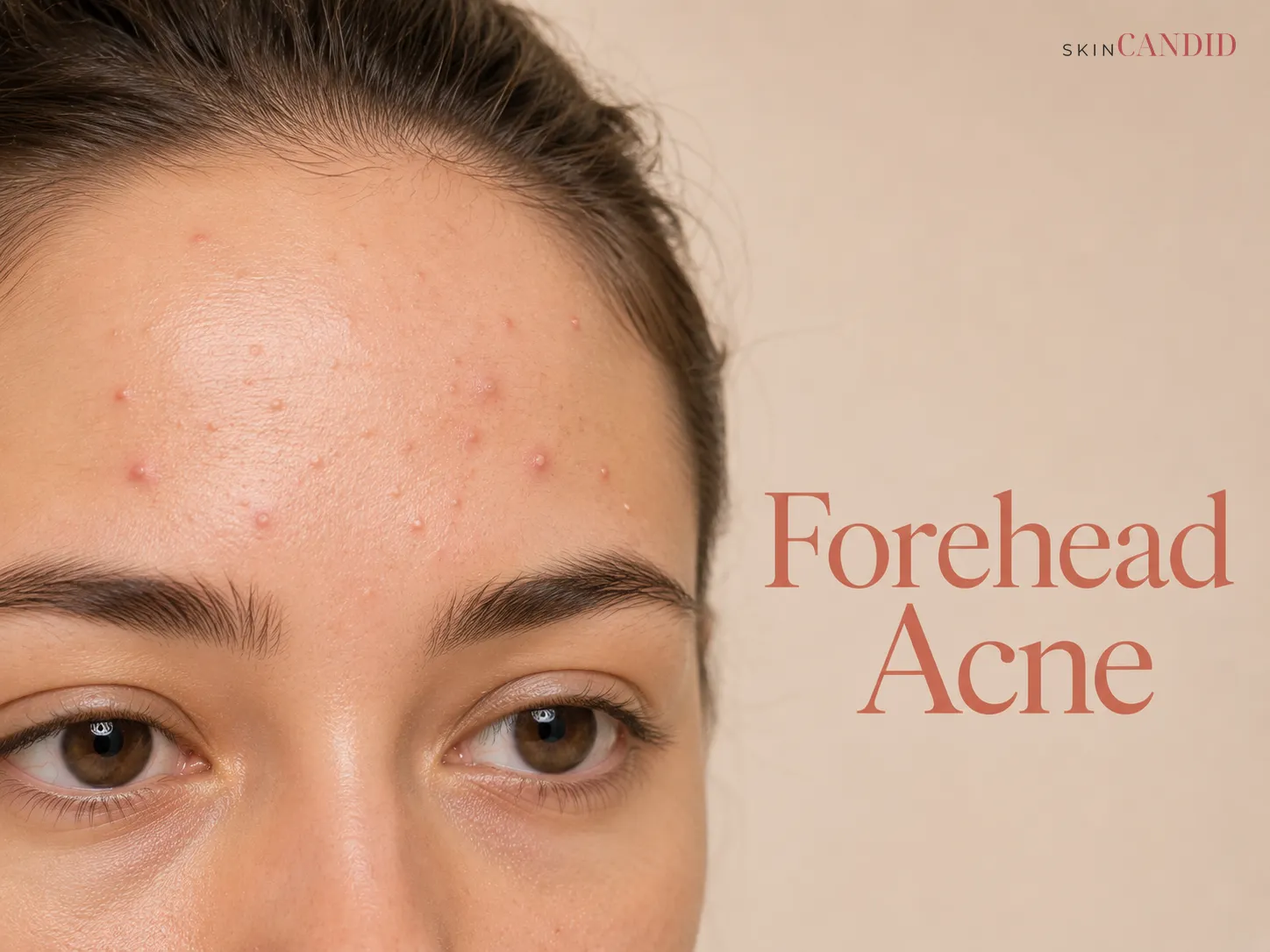
Forehead acne describes breakouts concentrated across the forehead and temples, an oil-rich T-zone area frequently affected by hair product residue, friction from fringes and headwear, in addition to the usual acne process.
Overview
What is forehead acne?
Forehead acne is acne concentrated on the forehead and temples rather than the cheeks or jaw. The forehead sits within the T-zone, the central forehead, nose and chin area that tends to carry more sebaceous glands and oil than the rest of the face, and it is also the area of the face in closest, most constant contact with the hairline.
Because of this, the forehead is a common site for acne linked to hair care products and headwear friction, alongside ordinary acne that can affect this area at any age.
Common signs and patterns
What forehead acne can look or feel like
These features can provide context, but they do not confirm a diagnosis on their own.
Small closed comedones
Tiny, flesh-coloured bumps often cluster across the forehead and along the hairline.
Concentration along the hairline
A pattern that hugs the edge of the hairline can point toward hair product or headwear contact.
Mild T-zone shine
The forehead often looks and feels oilier than the cheeks due to higher sebaceous gland density.
Comedonal-dominant pattern
The forehead often shows more blackheads and whiteheads than deep inflamed lesions.
Causes and contributors
Hair products and headwear friction add to the forehead’s own oil-rich tendency.
Oils and silicones in shampoo, conditioner, dry shampoo, styling gel and pomade can migrate onto the forehead and clog pores, a pattern sometimes called acne cosmetica. Fringes, hats, headbands and helmets add friction and trap oil against the skin, and pillowcases can carry product residue back onto the forehead overnight.
Underneath these contact factors, the forehead’s naturally higher concentration of sebaceous glands means it is already prone to blocked follicles, independent of any product use.
What it may be confused with
Similar-looking concerns need different decisions
Bumps and flaking on the forehead are not automatically acne.
Milia
Small, firm white bumps that are trapped keratin rather than blocked, oily follicles.
Seborrheic dermatitis
Causes flaking and redness along the hairline and forehead rather than true comedones.
Folliculitis
Inflammation around hair follicles can look similar, sometimes linked to headwear or sweat.
Rosacea
Can extend to the forehead with redness and bumps but usually without comedones.
Bottom line
Adjust hair contact first, then keep treatment consistent.
Switching to labelled non-comedogenic hair and styling products, and keeping fringes and headwear cleaner, removes a common added trigger.
Topical acne treatment still needs several weeks of consistent use to judge whether it is working.
Evidence-supported options
Choose the option that matches severity and pattern
This is general education, not a personal treatment plan. Product strengths, permitted uses and prescription status vary by country.
Topical retinoids
Help prevent blocked follicles and are well suited to a comedonal-dominant pattern.
Limit: Irritation is common during introduction, especially if hair products are also contributing.
Salicylic acid or benzoyl peroxide
Help loosen material within clogged pores and reduce inflammatory breakouts.
Limit: Can dry or irritate skin, particularly along the sensitive hairline.
Switching to non-comedogenic hair products
Choosing labelled oil-free, non-comedogenic shampoo and styling products can reduce residue reaching the forehead.
Limit: Clearing from product changes alone can take about four to six weeks.
Prescription combinations
Topical combinations or oral treatment may be appropriate for persistent or widespread forehead acne.
Limit: Requires clinician selection and monitoring.
Supportive skincare
A simple routine while forehead acne is being managed
Supportive skincare should account for both the forehead’s own oiliness and its contact with hair and headwear.
Morning
- Cleanse gentlyUse a mild cleanser and rinse the hairline thoroughly.
- Apply treatment if directedFollow the product label or clinician’s instructions.
- Moisturise and protectUse a non-comedogenic moisturiser and daily sunscreen.
Evening
- Wash out styling productsRinse hair products thoroughly before bed where possible.
- Cleanse the forehead onceRemove sunscreen and residue without rough cloths.
- Use the selected acne treatmentIntroduce gradually and avoid combining several new actives at once.
Common mistakes
What can make forehead acne harder to manage
- Overlooking shampoo, conditioner and styling products as a possible source of pore-clogging residue.
- Wearing tight headbands, caps or helmets without cleaning them regularly.
- Scrubbing an oily forehead harder, which increases irritation without addressing blocked pores.
- Expecting a product switch to clear breakouts in a few days rather than several weeks.
When professional help makes sense
Seek assessment when forehead acne is persistent or unclear in cause.
- No improvement six weeks after switching to non-comedogenic hair products
- Deep, painful lesions or scarring across the forehead
- Uncertainty about whether the pattern is acne, seborrheic dermatitis or milia
- Widespread or rapidly worsening breakouts
Related reading
Continue with the next useful question
Editorial record
What this page knows, and what remains uncertain
Evidence summary
Authoritative dermatology guidance recognises acne cosmetica from hair and styling product residue, and describes the forehead as part of the higher-sebum T-zone.
Review status
Financial transparency
No paid product placement or affiliate ranking is included on this foundation page.
Recommendation logic
Options are organised by evidence grade, with hair-product adjustments presented as supportive rather than a substitute for topical treatment.
Frequently asked questions
Short answers to common questions
Can hair products really cause forehead acne?
Yes. Oils and silicones in shampoo, conditioner and styling products can migrate onto the forehead and clog pores, a pattern sometimes called acne cosmetica.
Why is my forehead oilier than the rest of my face?
The forehead sits within the T-zone, an area with a higher concentration of sebaceous glands than the cheeks, so it tends to produce more oil.
How long does it take for forehead acne to clear after switching hair products?
Improvement from removing a hair-product trigger is often seen within about four to six weeks of consistent avoidance.
Should I cut bangs if I have forehead acne?
A fringe is not required to be removed, but keeping it clean and away from styling product residue, and washing it regularly, can reduce added contact and friction.
Sources reviewed
Guidance behind this page
- American Academy of Dermatology: Are your hair care products causing breakouts?
- StatPearls (NCBI Bookshelf): Acne Vulgaris — pathophysiology and facial distribution
Sources support general editorial guidance. They do not replace regional product labels, prescribing information or personal medical assessment.