
Breakouts & Pores
Hormonal Acne
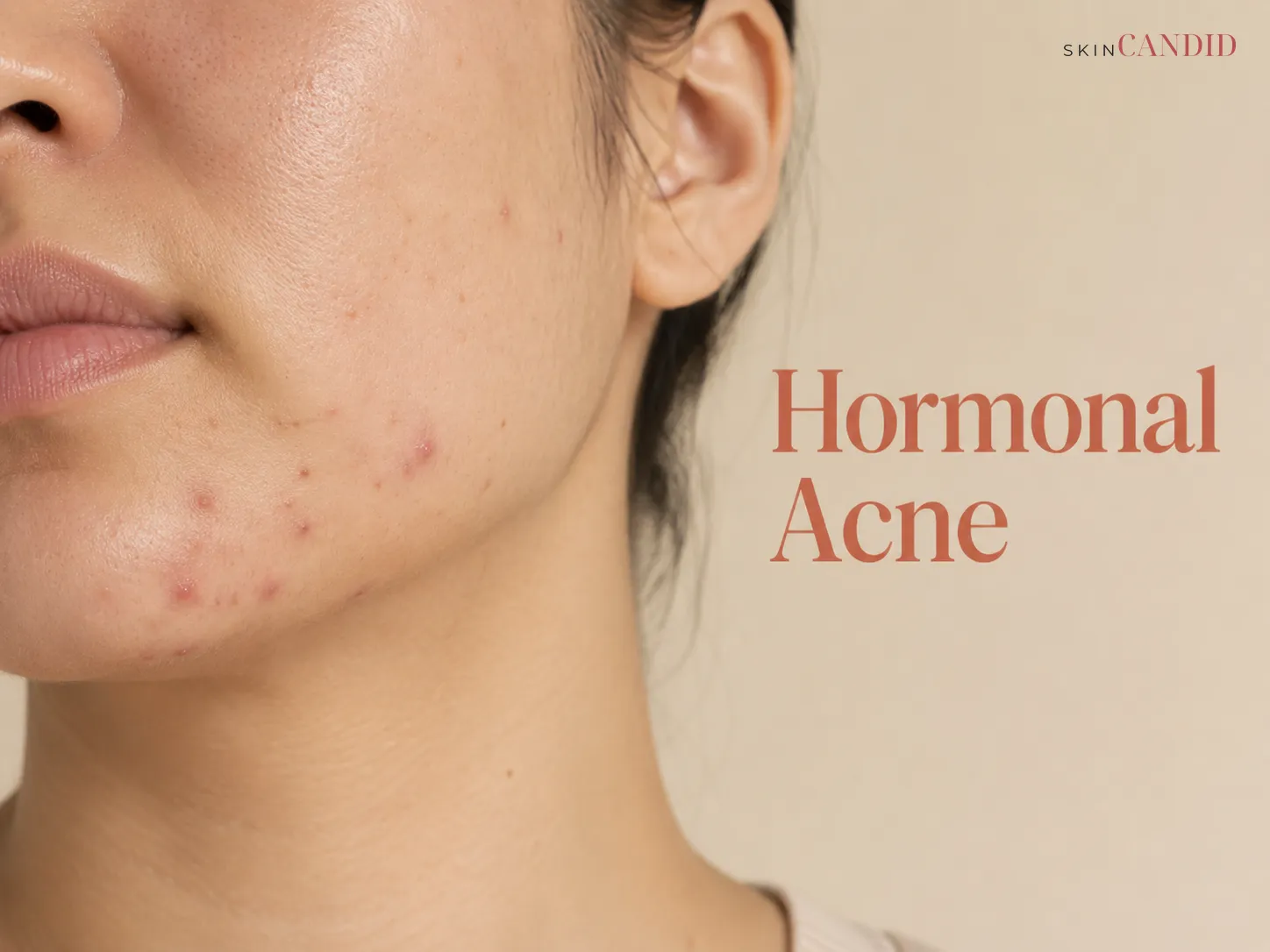
Hormonal acne is breakouts driven by hormonal changes that increase oil production, most often concentrated along the jawline and chin and most widely recognised in adult women.
Overview
What is hormonal acne?
Hormonal acne describes breakouts linked to hormonal changes that increase the amount of oil the skin produces. That oil interacts with bacteria in hair follicles, contributing to blackheads, whiteheads, papules and, in some cases, deeper cyst-like lesions.
It primarily affects adults aged roughly 20 to 50 and is particularly common in women, with breakouts often concentrated along the jawline, chin, lower face and neck, though the cheeks, back, shoulders and chest can also be affected. It can also occur in adolescence as part of normal pubertal hormonal changes.
Common signs and patterns
What hormonal acne can look or feel like
These features can provide context, but they do not confirm a diagnosis on their own.
Jawline and chin concentration
Breakouts often cluster along the lower face rather than the forehead.
Deep, tender lesions
Papules and nodules can sit deeper in the skin and feel more painful than surface bumps.
Cyclical timing
Flares that recur around the same point in the menstrual cycle are a hallmark of hormonal acne.
Adult-onset pattern
Breakouts that begin or persist well beyond adolescence often point toward a hormonal contributor.
Causes and contributors
Androgens increase sebum production and sensitivity in certain areas.
Hormonal acne is largely driven by androgen hormones, which stimulate sebaceous glands to produce more oil. Fluctuations around the menstrual cycle, pregnancy, stopping hormonal birth control, perimenopause and conditions such as polycystic ovary syndrome can all trigger or worsen it. Around half of women in their twenties and about a quarter of women in their forties experience hormonal acne.
Stress and insufficient sleep can also affect hormone levels and may worsen breakouts, alongside the use of comedogenic skincare or hair products.
What it may be confused with
Similar-looking concerns need different decisions
Breakouts along the lower face are not automatically hormonal acne.
Rosacea
Centres on flushing and visible redness rather than comedones or deep tender lesions.
Perioral dermatitis
Clusters around the mouth and usually lacks the comedones typical of acne.
Ingrown hairs
Shaving-related bumps along the jaw can mimic hormonal acne without a hormonal cause.
Non-hormonal acne
Acne unrelated to hormones can appear anywhere on the face and does not reliably follow a cyclical pattern.
Bottom line
Give treatment time, and consider hormonal options when topicals plateau.
Most hormonal acne treatments need four to six weeks before improvement becomes clear, and hormonal therapies are often assessed over two to three months.
Persistent lower-face breakouts with a cyclical pattern are one of the clearer signals that a hormonal-aware plan may help.
Evidence-supported options
Choose the option that matches severity and pattern
This is general education, not a personal treatment plan. Product strengths, permitted uses and prescription status vary by country.
Topical tretinoin or other retinoids
Can help treat blackheads and whiteheads associated with hormonal acne.
Limit: Irritation is common during introduction and pregnancy-related restrictions apply.
Topical retinoids combined with antibiotics
Can help address inflammatory lesions when comedones alone are not the main issue.
Limit: Antibiotic use should follow resistance-aware, time-limited guidance.
Combined oral contraceptives
Certain formulations are FDA-approved to treat acne in women, with results often assessed over two to three months.
Limit: Requires clinician assessment of individual risk factors.
Spironolactone or steroid injections
Spironolactone can reduce breakouts and oiliness in women; steroid injections may help individual cystic lesions.
Limit: Prescription only, with monitoring; not appropriate for men.
Supportive skincare
A simple routine while hormonal acne is being managed
Supportive skincare should improve comfort and treatment tolerance without replacing the selected treatment.
Morning
- Cleanse gentlyUse a mild cleanser and lukewarm water without scrubbing.
- Apply treatment if directedFollow the product label or clinician’s instructions.
- Moisturise and protectUse a non-comedogenic moisturiser and daily sunscreen.
Evening
- Remove makeup and sunscreenCleanse once without rough cloths or brushes.
- Use the selected acne treatmentIntroduce gradually and avoid combining several new actives at once.
- MoisturiseSupport the skin rather than trying to dry every lesion out.
Common mistakes
What can make hormonal acne harder to manage
- Treating persistent jawline or chin breakouts only as a surface problem without noting a cyclical pattern.
- Stopping hormonal or topical treatment after a few weeks because results are not immediate.
- Assuming hormonal acne only affects teenagers, when it is especially common in adult women.
- Combining several strong actives at once instead of introducing treatment gradually.
When professional help makes sense
Seek assessment when hormonal acne is deep, persistent or complex.
- Deep, painful nodules or breakouts that reliably recur around the menstrual cycle
- No meaningful improvement after a consistent evidence-based treatment period
- Suspected polycystic ovary syndrome or other hormonal conditions
- Pregnancy, pregnancy planning or interest in hormonal therapy
Related reading
Continue with the next useful question
Editorial record
What this page knows, and what remains uncertain
Evidence summary
Current dermatology guidance supports the role of androgens in increasing sebum production, describes a common lower-face distribution, and supports hormonal therapy as an option for appropriately selected women.
Review status
Financial transparency
No paid product placement or affiliate ranking is included on this foundation page.
Recommendation logic
Options are organised by evidence grade and the point at which hormonal or prescription therapy becomes a reasonable next step.
Frequently asked questions
Short answers to common questions
How do I know if my acne is hormonal?
Hormonal acne often concentrates along the jawline and chin, feels deeper and more tender, and tends to flare around the same point in the menstrual cycle, though a clinician’s assessment can confirm this.
Does hormonal acne only affect teenagers?
No. While hormonal changes during puberty can cause acne, hormonal acne is also especially common in adult women, affecting around half of women in their twenties and about a quarter of women in their forties.
How long does hormonal acne treatment take to work?
Topical treatments often need four to six weeks of consistent use, while hormonal therapies such as combined oral contraceptives are typically assessed over two to three months.
Can birth control help hormonal acne?
Certain combined oral contraceptives are approved to treat acne in women by reducing androgen-related sebum production, though this requires a clinician’s assessment of individual risk factors.
Sources reviewed
Guidance behind this page
- Cleveland Clinic: Hormonal acne — causes, treatment and prevention
- American Academy of Dermatology: Stubborn acne? Hormonal therapy may help
- StatPearls (NCBI Bookshelf): Acne Vulgaris — pathophysiology and facial distribution
Sources support general editorial guidance. They do not replace regional product labels, prescribing information or personal medical assessment.