
Breakouts & Pores
Adult Acne
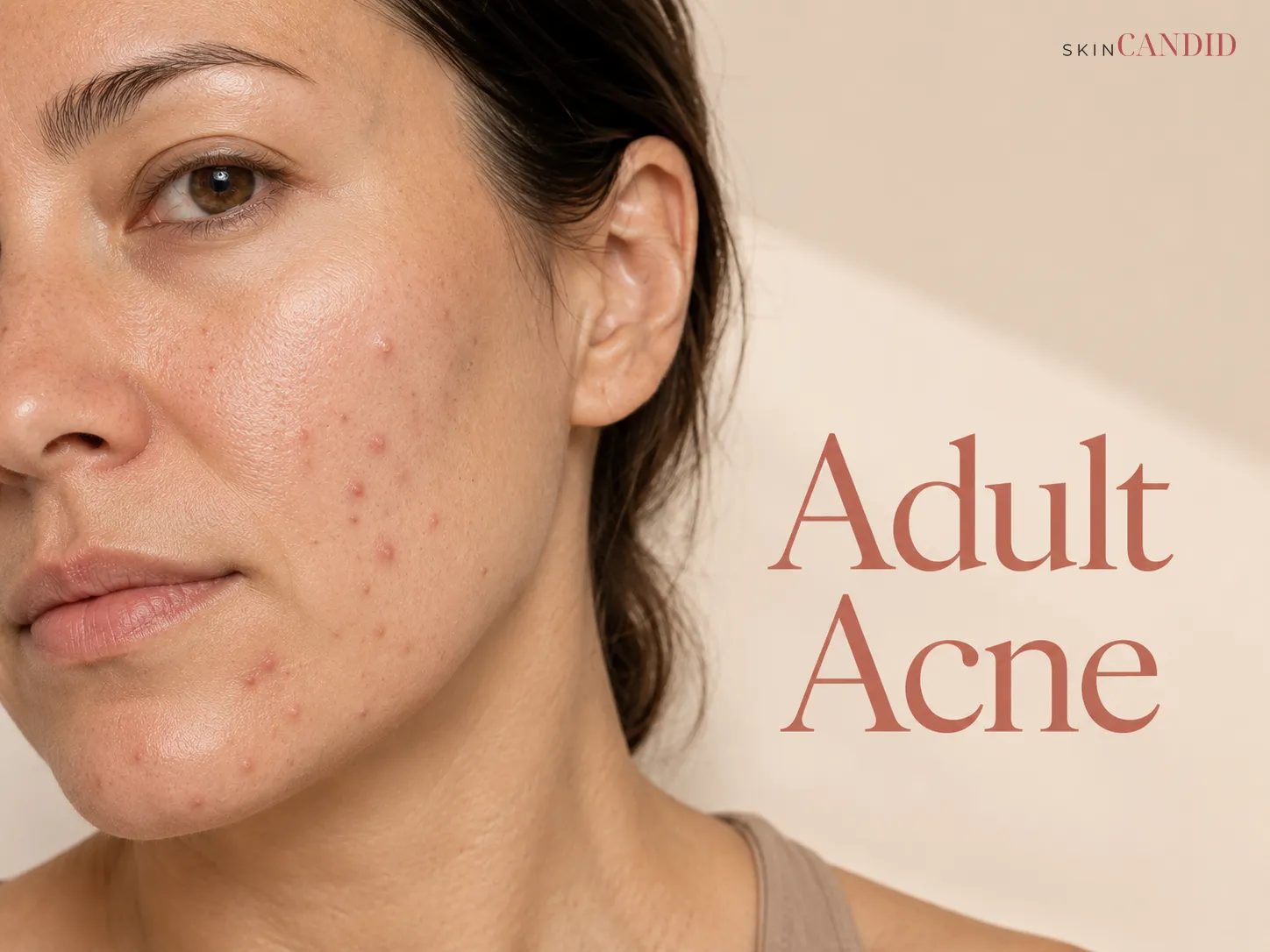
Adult acne is acne that continues past the teenage years or begins for the first time in adulthood, often clustering along the jawline and lower face rather than the forehead and nose.
Overview
What is adult acne?
Adult acne describes acne that continues into or persists through the 30s, 40s and beyond, as well as acne that appears for the first time in adulthood, sometimes called adult-onset acne. It affects women more often than men and is frequently linked to hormonal changes.
Rather than the broader forehead-and-nose pattern often seen in the teenage years, adult acne tends to concentrate along the jawline, chin and lower cheeks.
Common signs and patterns
What adult acne can look or feel like
These features can provide context, but they do not confirm a diagnosis on their own.
Jawline and lower-face breakouts
Lesions often concentrate around the jaw, chin and lower cheeks rather than spreading across the forehead.
A mix of comedones and inflamed spots
Blackheads, whiteheads, papules and small pustules can appear together rather than one dominant lesion type.
Flat healing marks
Red, pink or brown marks can linger after individual breakouts settle, distinct from raised or indented scarring.
Flares tied to the menstrual cycle
Breakouts that predictably worsen in the days before a period can point to a hormonal pattern.
Causes and contributors
Hormonal fluctuation is a leading driver of adult acne.
Changes across the menstrual cycle, pregnancy, perimenopause and menopause, as well as starting or stopping hormonal birth control, can all influence oil production and contribute to breakouts. Stress-related increases in androgen hormones can also stimulate oil glands and hair follicles.
Adult skin is often more prone to dryness and barrier sensitivity than teenage skin, which means products and routines that worked well in the teenage years can become too harsh or drying later on.
What it may be confused with
Similar-looking concerns need different decisions
Adult breakouts do not always follow the same pattern as teenage acne, so it helps to rule out other explanations first.
Rosacea
Centres on facial redness, flushing and inflammatory bumps rather than the comedones typical of acne.
Perioral dermatitis
Often clusters tightly around the mouth, nose or eyes and usually lacks the comedones typical of acne.
Hormonal acne
A specific hormonally driven pattern that can overlap with adult acne but is not present in every case.
Teenage acne
Tends to spread more broadly across the forehead and nose, with skin that is typically less prone to barrier sensitivity.
Bottom line
Match treatment to adult skin’s tolerance, not to teenage-strength products.
Gentler formulations, gradual introduction of actives and attention to the skin barrier usually work better for adult acne than the stronger, drying products often used in the teenage years.
Most treatments need several weeks of consistent use before the direction of improvement becomes clear.
Evidence-supported options
Choose the option that fits an adult skin barrier
This is general education, not a personal treatment plan. Product strengths, permitted uses and prescription status vary by country.
Topical retinoids
Help prevent blocked follicles and can improve both breakouts and early fine lines over consistent use.
Limit: Irritation can be more noticeable on drier adult skin, and pregnancy-related restrictions require professional guidance.
Azelaic acid
A gentler option that may help acne and post-acne discolouration with a generally lower irritation profile.
Limit: Results are gradual and some people notice mild tingling on application.
Hormonal treatment
Combined oral contraceptives or spironolactone may be considered for suitable candidates with a hormonally influenced pattern.
Limit: Requires clinician assessment of individual hormonal profile, health history and any pregnancy considerations.
Prescription combination therapy
Topical combinations or oral antibiotics may be appropriate for persistent or moderate adult acne.
Limit: Requires clinician selection, monitoring and resistance-aware prescribing.
Supportive skincare
A simple routine that respects an adult skin barrier
Supportive skincare should protect comfort and treatment tolerance rather than adding more strong actives.
Morning
- Cleanse gentlyUse a mild, non-stripping cleanser rather than a harsh foaming or astringent formula.
- Apply treatment if directedFollow the product label or clinician’s instructions.
- Moisturise and protectUse a non-comedogenic moisturiser and daily broad-spectrum sunscreen.
Evening
- Cleanse onceRemove makeup and sunscreen without rough cloths or brushes.
- Introduce actives graduallyAdd one new treatment at a time rather than several at once.
- MoisturiseSupport the skin barrier overnight rather than trying to dry every spot out.
Common mistakes
What can make adult acne harder to manage
- Reusing harsh, drying products that worked in the teenage years but now irritate a more sensitive barrier.
- Assuming breakouts reflect poor cleanliness and over-washing or scrubbing as a result.
- Overlooking a hormonal pattern, such as flares that predictably worsen before a period.
- Combining several strong actives at once instead of introducing them one at a time.
When professional help makes sense
Seek assessment when the pattern is persistent or hormonally complex.
- Persistent jawline or lower-face breakouts not improving with a consistent routine
- Acne appearing for the first time in adulthood with no clear trigger
- Interest in hormonal treatment, or acne during pregnancy or pregnancy planning
- Scarring, persistent marks or a significant impact on wellbeing
Related reading
Continue with the next useful question
Editorial record
What this page knows, and what remains uncertain
Evidence summary
Authoritative dermatology sources describe adult acne as often hormonally influenced, more common in women, and best managed with formulations suited to a more sensitive adult skin barrier.
Review status
Financial transparency
No paid product placement or affiliate ranking is included on this foundation page.
Recommendation logic
Options are organised by tolerability for adult skin, hormonal relevance and the point at which professional care becomes appropriate.
Frequently asked questions
Short answers to common questions
Why am I getting acne as an adult when I never had it as a teenager?
Adult-onset acne can occur and is often linked to hormonal changes such as perimenopause, pregnancy, or starting or stopping hormonal birth control.
Is adult acne treated differently from teenage acne?
Adult skin is often more prone to dryness and sensitivity, so gentler formulations and gradual introduction of actives are usually recommended rather than the stronger products sometimes used as a teenager.
Does diet cause adult acne?
Diet may play a role for some people, but it is not the only cause and evidence does not support blaming a single food in every case.
Can adult acne be hormonal even without other symptoms?
Yes. Jawline-focused breakouts that flare around the menstrual cycle can reflect hormonal influence even when no other symptoms are present.
Sources reviewed
Guidance behind this page
Sources support general editorial guidance. They do not replace regional product labels, prescribing information or personal medical assessment.